Archive | Pinkguitarfarm – General RSS feed for this section

Cousin Itt? Nah, just onion seedlings.

16 Jan

Farm seedlings for January: Onions

I went a little crazy with the onions this year. I’m told that onion seeds lose a large percentage of viability after the first year so I gathered up all of my old (and new seeds) and planted them. They all germinated! Now the challenge is to figure out where to put them all when spring planting time comes.

I believe that all great meals start with something from the allium genus. Good for companion planting with cabbages and in helping to deter rabbits, onions are a must in any garden.

Here’s a little preview of what we’re growing this year at Pinkguitarfarm.

Rear, left to right:
Scotland Leeks – an heirloom variety from Scotland this leek is described as “hardy, short-shanked, (with) excellent flavor and texture.” Seeds of Change. I bought this because it is a good variety to overwinter or keep in the greenhouse. I immediately envision a creamy potato leek soup when I see the picture on the package. However, this spring I’ll be indulging in some roasted baby leeks with an herb marinade and baby leeks with fennel braised in cream, hmmm, I wonder if they will all make it to winter.

Shimonita Negi – Japanese Bunching Onion Single Stalk Type. From the packet: “(365 days) King of the Negi, this single stalk Japanese bunching onion is worth the wait in seed to harvest time. It doesn’t get better than this for flavor which only gets sweeter with cooking! The short and fat white root makes the Shimonita Negi look more like a leek than a scallion. The chunky shape means this variety does not need deep soil mulching and a lot of extra work around harvest time. From the sowing to harvest (typically December)this is a one-year crop….The Shimonita Negi is popular throughout Japan, but particularly so in its place of origin, Shimonita Town, famous for its produce. Tourists are advised not to miss a particular Shimonita rest stop where the onions are sold during their season.” Kitazawa Seed Co. I’m a sucker for this kind of marketing, what can I say? Hope it’s worth an entire year of raised-bed real estate!

Mini Purplette Bunching Onion. From the packet: “The first purple red-skinned mini onion. Early maturing with delicate, mild flavor. Attractive either topped or bunched and can be harvested very young as baby bunching onions with purple pearl ends. Turns pastel pink when cooked or pickled”. Seeds of Change. Mmmm pickled!

Ed’s Red Shallot. From the packet: “Red skin with red interior. One bulb will produce up to 30 bulbs. Unique flavor is great for flavoring soups, salad dressings, vegetables and grain dishes”. Seeds of change. Cool! No more buying shallots at the grocery store…

Garlic chives. From the packet: “Heirloom, medicinal…Popular in 16th century European gardens for adding garlicky flavor to soups and salads. Hung inside homes to ward off malevolent spirits. Green seeds impart rich flavor to cooking oils. Leaves and flowers add spice. Also used in Chinese medicine to warm the kidneys and treat lower back and knee pain”. Seeds of Change. This one is indispensable for the garden, kitchen, household and body! Don’t you love the word “garlicky”?

Center, left to right:
Red Beard – Japanese Red Bunching Onion Splitting Type. From the packet: “This popular specialty red-stalked bunching onion has a mild pungent flavor and tender leaves…The red color is stimulated by cold temperatures. Mature plants can reach 26” tall. Used in stir-fries, salads and as a garnish. Red Beard makes an unusual and attractive addition to the garden”. Kitazawa Seed Co. Hmm. Wonder if it will be a big seller at the local farmers market, I may have to bring some recipes with this one. Can’t wait to see how it looks at maturity.

Texas Early Grano. From the web-site: “Texas heirloom, ‘The Mother of All Sweet Onions’ This Vidalia-type onion is a good choice for the Mid-Atlantic and the South. Best started in the fall or winter and transplanted in early spring. Large top-shaped bulbs, thin skin, soft white flesh, with sweet mild flavor. Good resistance to splitting. Short keeper”. Southern Exposure Seed Exchange. Sweet onions are my fave, French onion soup anyone?

Japanese Bunching Onion Splitting Type – Menegi. From the packet: “This delicate white green onion is a young shoot of the wakegi scallion. Specially cultivated to produce young shoots that are used as a sashimi and sushi garnish. Menegi are harvested very soon after planting when the scallion has grown to a height of only 3”-4”. Because they are harvested when they are young and thin, Menegi need heavy planting”. Got the garnish, need the sashimi! Oishii desu ne!

Front, left to right:
More Scotland Leeks, see description above.

Cipolla/Long of Florence. From web-site: “Long (4 inch) narrow red onion. Wider in middle than the ends. Mild sweet taste. Beautiful. Medium/long day type. Mid season harvest. Use in salads but stunning grilled or on skewers”. GrowItalian.com I LOVE, love, love ALL my Franchi seeds!

More Cipolla/Long of Florence, see directly above.

More Texas Early Grano, see above.

Bunching, Deep purple. From the web-site: “A new development in bunching onions. This reddish-purple variety develops and retains its color throughout its growth period and through high and low temperatures”. Southern Exposure Seed Exchange. I like purple.

Here’s to a great year of onions! Onions are easy to start and grow. From quickie chives to large bulbs there are enough varieties to keep you in onions year round in your own garden, so people, please start your onions!

Jack and Jane, patrolling

13 Jan

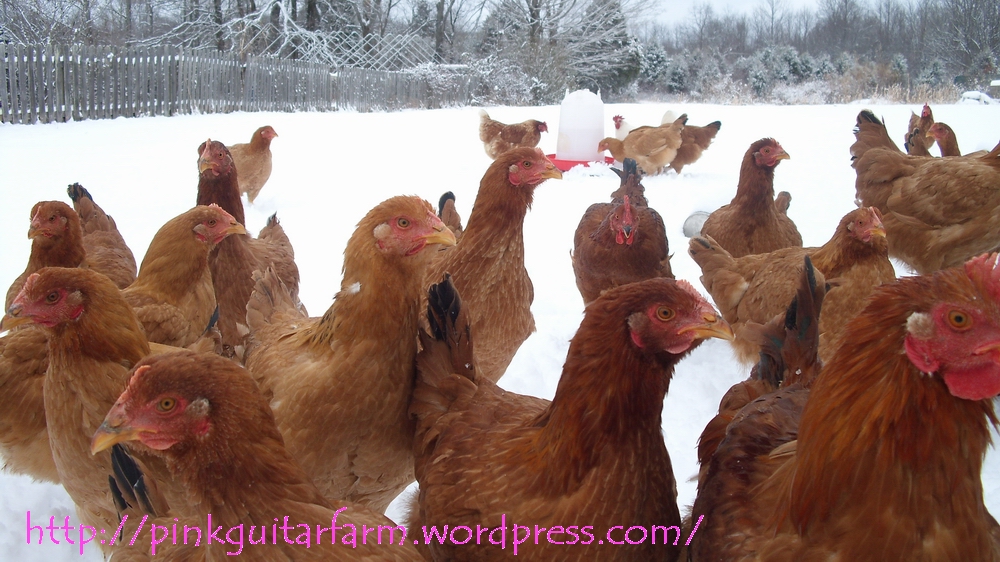
The sun came out today and everyone on the farm was delighted! Jack and Jane made sure the chickens were safe from hungry hawks while Sophie and I filled water buckets and replenished hay. The air was crisp and the snow was beautiful!

Free Range Snow Chickens!

11 Jan

Porky research and the Red Wattle Hog

6 Jan

When I started growing vegetables I wanted things I couldn’t get easily at the store. I wanted weird stuff that no one had ever seen and to make dishes nobody else had ever tasted. I’ll admit it, I’m a food adventurer, a trait encouraged and nurtured while only a 10 year old child on sabbatical with my family as we traversed around the world. We lived in Japan and Sweden during that journey for six months each and it was immersion into these cultures, and others along the way that opened my eyes to so many wonderful choices in food.

Heirloom fruits and vegetables are therefore an obvious component in my garden. So too, are heritage farm animals, which brings us to the elusive and extraordinary Red Wattle Hog or Pig, depending. And really, just what is the difference between a hog and a pig? Just like heirloom plants, heritage animals must be consumed in order to continue on.

If there is no added benefit in the form of taste, better flavor, hardiness, regional adaptability, or an incredibly unique finished product, they will not survive our industrialized world. And if you have read this far, please check out this post a story regarding Adam and Eve, two 8 week old Red Wattles that traveled from Kansas to live in the Napa Valley. Especially thought provoking, are the comments in this link, there are excellent rhetorical questions posed and insights revealed.

Luckily, the Red Wattle population is increasing and most Red Wattle farmers are passionate about their cause. Although touted as a trendy foodie item for several years (yet again, another Adam and Eve reference), I hope that more people have the opportunity to taste heritage meat and learn about these animals with an eye towards preservation, animal welfare and excellent flavor. To know that meat raised the way it is supposed to be raised has better flavor and that more small farmers are supported in doing so, is a win, win situation for all local communities.

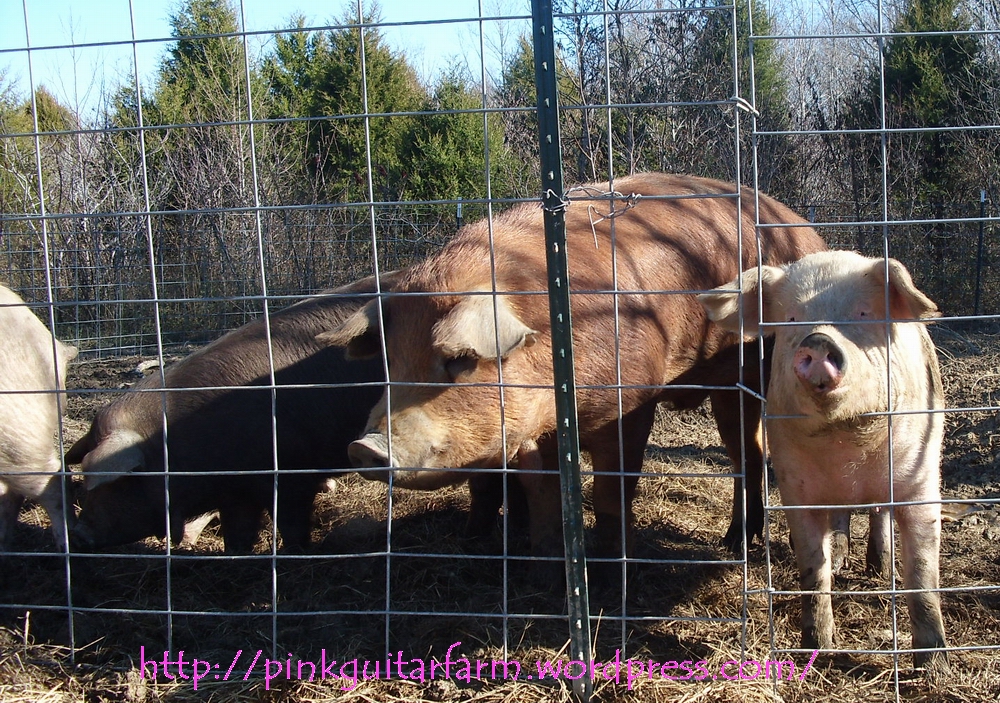
Raising Red Wattle Hogs is an honor. We have Yorkshire/Landrace/Hampshire cross gilts alongside the Red Wattles and the Red Wattles appear to be more primitive and old-fashioned. They are larger, grow faster, forage better, hold up to the weather and thrive in the woodlot and pasture. The Red Wattles have been referred to as dinosaurs and, I’ll admit, they do have a primordial look to them. When surprised or scared, they bark like a dog and hop around in circles, it’s a sound from the past, eerily prehistoric and oddly appropriate for their looks.

The white pig on the right is about 300 pounds - for perspective

Where did they come from? I wonder if they are a genetic remnant from our ancient past, a treasure that has been rediscovered and/or a delicious unsolvable mystery. Regardless, we are lucky to have them.

And by the way, what ever happened to the cute little piglets named Adam and Eve that got to go live in the Napa Valley?

So, with fingers crossed while knocking on wood (ow!), If all goes well, we should have our own farm raised Red Wattle piglets in about 4 months! If you are interested in a piglet of your own to raise, or a whole or half, please contact us at pjmatthews7750@gmail.com

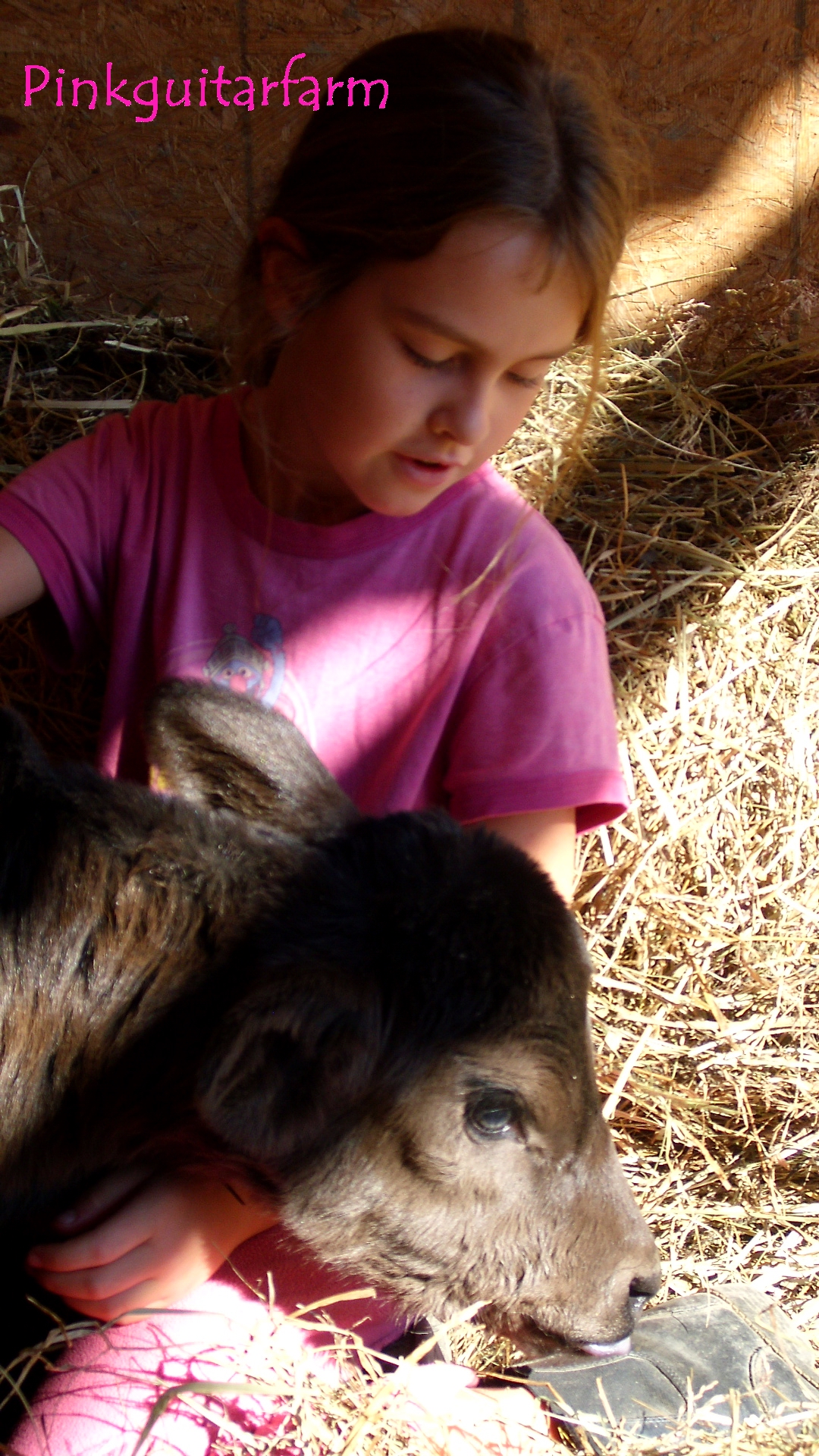
Meet T-Bone our bottle baby bull calf

10 Nov

If you drop your kids off at school in the morning as I do occasionally, when a.m. chores run long, unexpected conversations can and do take place. This one was with the kids’ gym teacher it went like this:

Him: “Hey, would you all be interested in a baby calf?”
Us: “sure!”

I didn’t even ask my husband…

So one week old “T-Bone” was carefully delivered to pinkguitarfarm on October 30, 2010, a beautiful Saturday morning.

He came with his own bottle and a lesson in bottle feeding. Although he was none to happy about being separated from his twin brother and mama…he reluctantly accepted the bottle and slowly warmed up to us.

T-Bone is now almost 3 weeks old now. He is drinking enthusiastically and follows us around in his pen, happily trotting behind us, always looking for an udder(!). He has quite the cute, albeit insistent “moo” when he hears us first thing in the morning and in the evening during our routine feeding chores, he gets his bottle last because it has to be warmed and mixed to perfection.

We think that T-Bone is ready for a bucket and maybe a little bit of grain, but it has to be added very slowly to his diet. He is also ready for some halter work and lead line training. Maybe he will make a good 4H calf? Time will tell. Moooo…

It’s elementary, my dear…

1 Nov

Our kids attend a small rural public school. There are 103 students in attendance, kindergarten through 5th grade. It is a cheerful place with shiny hardwood floors in the hallways, happy smiles on the teachers faces and the kids are all known by first name; as are parents and grandparents. Generations of local residents have attended this special 50+ year old elementary school and it acts as a hub for this unique community. Sound too good to be true?

Last month the School Board voted 10 to 1 to close this little school down for the 2010/2011 fiscal year as part of a rezone (of which ironically, the overall rezone has yet to be voted on). The stated issues were capacity and funding due to the small size of our school.

Our school was inequitable because our average classroom size was only 17:1. It was inequitable to our students because they were not offered classes in foreign language or extracurricular activities. Inequitable both ways. No alternative to closure was presented, discussed or even entertained.

Rural and urban schools are different. Rural and suburban schools are different. Cookie-cutter, one-size fits all approaches to our public education system are not working. Smaller schools and smaller districts are better for the overall community in rural areas.

Closing down this little school has been a blow to the community. Teachers wonder where they will work, how far they will have to commute. Students wonder if they will get lost in the system, lost in the higher student/teacher ratio’s, whether the new staff will even know their names. Generations of people see their connection to the area unraveling through a system that has lost its concern for the community, lost its accountability to the children and turned a deaf ear to parents’ plea’s to keep the school open.

Just about the only thing the system has accomplished is the appearance of an arrogant, willful, objective towards leaving these children behind. Sound like we got our words mixed up here? Are we missing something? Propaganda statements about education reform have created a wide divide between theory and practice.

All in the name of budgeting, streamlining and efficiency. Efficient bus routes, clean feeder patterns, capacity… I keep missing the humanity in this equation. So do our community members.

I think it is time for a smaller district, one that can effectively represent its constituents.

Moving to the country gonna eat a lot of peaches…

25 Aug


What is it about the country life that evokes visions of peace, charm, freedom and solitude to some and isolation, hard work, boredom and inconvenience to others? Why are some people drawn to it and some people not?

I often think of my Grandfather who (according to him) was a real cowboy. I actually believe it more now than I did as a kid. I grew up in the Midwest in a college town and only knew of the “cowboy” through Hollywood depictions. Grandpa wore the right boots, shirts and denim to fit the stereotype but that’s where it ended. He was probably the only real cowboy I’ve ever met and yet he was one of the kindest, gentlest spirits I have ever known.

My grandfather moved from North Dakota to Los Angeles in his early 30’s when job growth was becoming the big deal out in CA. This must have been during the late 1930’s. Although he eventually owned several acres in the greater L.A. area in order to keep his horse, his heart just wasn’t there. I believe that he despised the noise, the dirty air, the concrete and the (too fast for him) pace of life. Grandpa couldn’t wait to get out of L.A. and move to Montana. He retired early and did just that.

Some people love the energy of a big city. They love the shopping, the restaurants, the social scene, the traffic, the noise. I guess I’m not one of those people. I want dark nights where I can see the stars, I want to hear only the bugs and the birds. I want to be in uninterrupted contact with nature and I don’t want to visit it, I want to exist in it. I am like my grandfather in that regard. But I had to come full circle (just like he did) to get there.

Now that I am really out “in the hills”, I have met country people and shockingly, they don’t seem to “fit” all the “stereotypes” either! The wisdom they have shared, the friendly help they have offered and the way they have welcomed my family into this community has been amazing. I also believe that some of the old-timers around here are truly a treasure.

First hand knowledge and experience is invaluable to anyone just starting out on a farming journey – there is so much to learn. I have asked for and received information about chickens, pigs, cows, goats, tomatoes, potatoes, okra, putting in a pond, butchering, cooking, making wine, moonshine, the history of this area, how to treat poison ivy (medicinally) and where to buy my hog panels. Oh, and how to grow a lot of peaches.

I know people that utilize Hollywood stereotypes to describe country folk, or anyone different than they are, actually. The comments based on these stereotypes can get pretty ugly. Since the saying goes: Arguing with a fool makes you a greater fool, why comment. However, I find it interesting that these put-downs are devoid of first-hand personal experiences. Where do these concepts about country people come from? Movies that portray “Hillbillies” as ignorant and in-bred or as scary deviant murderers? If you travel at all, you know that people are people, where ever you go. So why do some people feed into these stereotypes? Doesn’t this behavior act as a way to divide us rather than allow for a cultural appreciation of the different regions and communities that America has to offer? Clearly stereotypes are everywhere, including the South, but really, can’t we all just get along?

According to Tom Dorrance, “the long way is the short way” when training horses. I think my Grandfather subscribed to a similar philosophy. I think this applies to the small-holder as well. I’d like to add that “the old way is the new way” in sustainable farming, you just have to go back far enough. All the talk about re-localizing and organic/sustainable farming is great for our communities. However, the irony is that some of these old country folk or “Hillbillies” If you will, are living-history regarding certain farming practices that have almost been completely lost. And you can bet your peaches I’ll be covering this stuff.

As it is, I moved to the country and am eating a lot of peaches, but the best part about being here is the people. I could not effectively farm without their knowledge or help. Clearly people are either cut out for country life or not. I say, if you want to find happiness, ignore the stereotypes and do what you are passionate about. It may take a while, require sacrifice and even some huge lifestyle changes – but if it’s your path, take it.

Winner, winner chicken dinner…

8 May

It’s hard to think about where our food comes from. Particularly when it’s so easy to go to the grocery store and throw that shrink-wrapped chicken breast in the cart for tonight’s dinner. The reason it’s hard to think about where it comes from (before it lands in the store) is because we don’t have to. If you delve into the topic and share what you learn, even in a way that children can understand, you might find a surprising number of people would just rather not know.

I had never owned a chicken prior to moving here. I had never eaten a truly free-range chicken egg before. I had never raised baby chicks and I had most certainly never processed a chicken.

The overall chicken experience here has evolved rather slowly over time, in stark contrast to our first on the job baby chick raising training – that was a trial by fire. We started out with 15 1-day old chicks from TSC that first April after moving here in early 2009. I let my son just randomly pick out chicks and then we picked 7 pullets. Pullets are supposed to be female chicks. If you buy your chicks “straight run” odds are you will end up with about 50% roosters. At the time, I’m not sure if we knew what any of those terms meant.

We lovingly started our baby chicks with all of the gear, a large, tall plastic storage bin, heat lamps, chick waterers, feed troughs and pine shavings. We immediately realized that this was a very high maintenance period in the life cycle of a chicken. They needed to be checked many times a day. They messed up the water, scattered the chick feed everywhere, and pooped A LOT.

What a relief to get them out to the coop and in a small enclosure so they could eat some grass, scratch around and act like a chicken.

After the chicks feathered out, we were able to tell if they resembled a Rhode Island Red, A Black Astrolorp or a Buff Orphington. We had a few of each and one Buff Orphington hen. And yes, of course we called her “Buffy”, she was our favorite.

Eventually they were large and agile enough to range freely. This was when we started counting our roosters. Uh, oh, we wanted A rooster or TWO. Not EIGHT. They comically started out with very sad, raspy crowing attempts. We giggled. They strutted around and established pecking orders, challenging each other with neck feathers fluffed out, wings forward and beaks striking. Our baby chicks, which we had tenderly held and named – didn’t really want us to hold them anymore. We felt rejected.

Needless to say, too many roosters can spoil a hen house. In fact, they were getting so aggressive that they were attacking our hens. And when they almost tried to kill our beloved Buffy that was the last straw.

So, we got on the internet and studied how to process a chicken. We set a date and gathered our courage along with our equipment. We put a large pot of water on the stove and made a plan. We really didn’t know what we were getting ourselves into.

Because our motivation to process these roosters arose out of our protective instinct for our beloved Buffy. We felt justified in our cause, that she had been wronged, and if we did not terminate and eat the two worst offenders, she would be gone. Justice must be served up in the form of fried chicken. Heck, if we sold them or gave them away chances are they’d meet the same fate, shouldn’t we at least get dinner for our efforts?

The two roosters were targeted. The first one went quickly, but the second one got wise and ran off. We finally got him too. Sweaty, tired and feeling a little sick; we tasked ourselves to the real work: plucking feathers.

After plucking, cleaning and cutting up the chicken, we were a little dismayed by the looks of our scrawny leggy chickens. They looked so much bigger running around with all of those feathers! They sure didn’t look like store bought chicken. We had read that they might be tough so we soaked them in buttermilk overnight in the refrigerator.

We ate fried chicken the very next day, a sunny Sunday summer afternoon. It was pretty good. It was a lot of work. We were exhausted, it had been a long, dramatic weekend.

One week later we had to do it all over again. As nature would have it, the next two most aggressive roosters jockeyed for position, reestablishing rank. Buffy was still getting attacked and they were just as vicious. We realized that all the roosters, save one, must go. That was a tough realization to swallow.

We went through a variety of methods and mishaps to achieve our goal of freezer roosters. Needless to say, there was a learning curve. I would hasten to add that all of our methods were planned and evaluated for what we felt would be the most humane/pain-free end to a chicken life. Theory didn’t always play out as we hoped in our fumbled attempts at practice. For those botched jobs, we are genuinely regretful.

Later, even that one remaining rooster, the last one, attacked Jack, our son and so he had to go into the freezer too.

With no more roosters, our hens laid their large beautiful free-range eggs in uninterrupted bliss. But with no more chicken meat in the freezer, and a palate developed along with a conscience for homegrown chicken, we tentatively started researching the different types of meat birds out there…