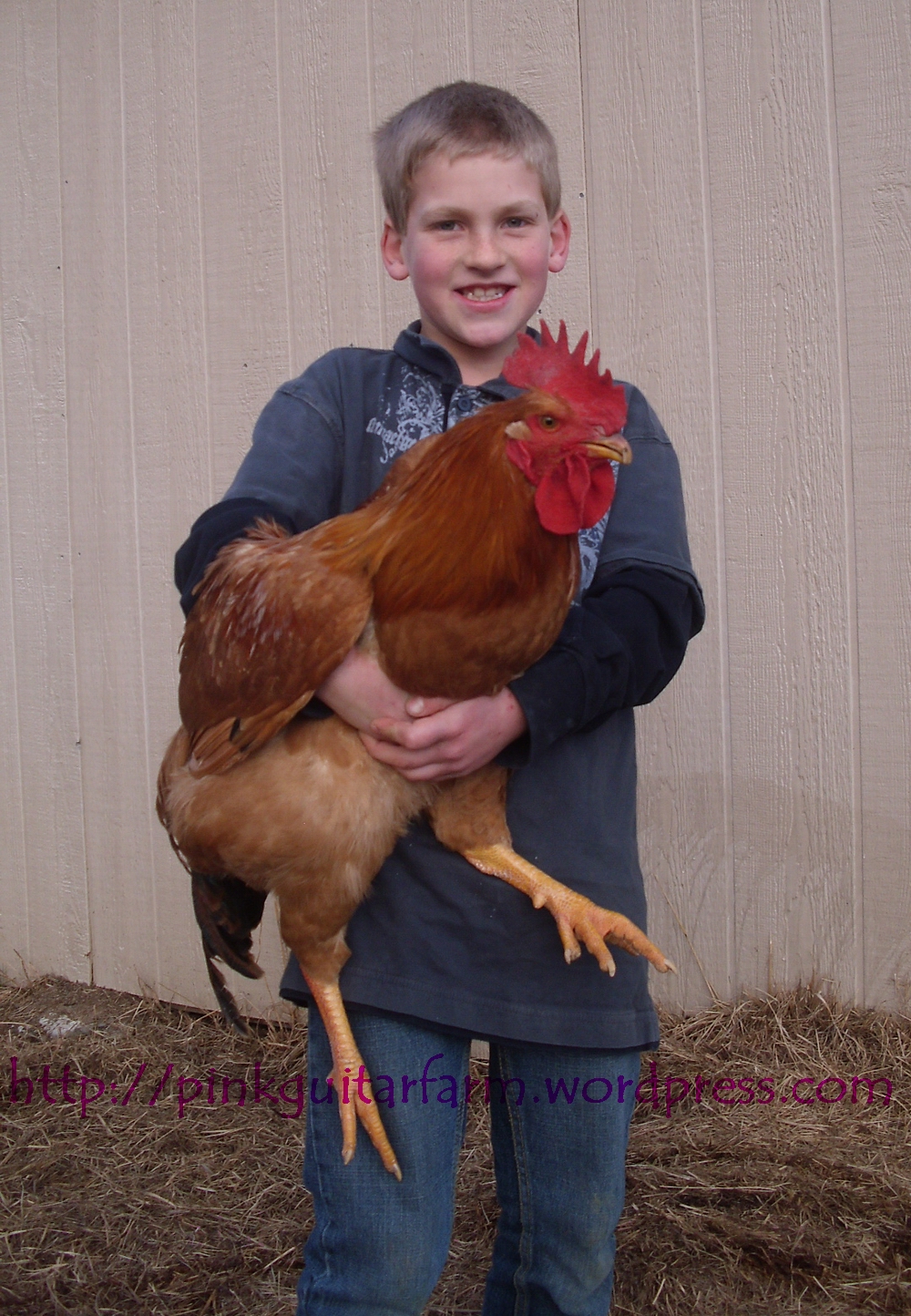
Heritage piglets, heirloom seeds. Happy Easter!

24 Apr

Though we have not slept in for eleven years (kids) our morning started more gradually than it should have. Mr. Pink Guitar ran a hay/mulch errand, meeting up with Farmer Joe, one of our kindest farmer friends who offered to give us rotten hay rolls for the garden. Free mulch, what’s not to love about that?

Mr. Pink Guitar indicated that he would do chores when he got back, so the rest of us drifted around sleepily making breakfast, reading and starting seeds. Mr. Pink Guitar must have spent a lot of time shooting the breeze with Joe (who is a wonderful conversationalist and oozes wisdom) because it seemed like hours before he got back. We’d finally decided to start chores just as the big ranch truck rumbled up the drive, trailer laden with hay in various states of decomposition.

Sophie left the house and wandered off to the barn right after the truck pulled up. Soon after I heard her scream, when I looked out the window she was running, arms flailing towards the truck. I got my muck boots on quickly, mentally prepared to face something terrible.

Roselle had farrowed, but what should have been a joyous occasion became somber as the situation revealed itself. Roselle was not showing interest in her piglets and had crushed two. Two more had not made it through the birthing process. We counted six tiny piglets skinny and shivering huddled in the corner, ignored. We tried to put a heat lamp on them and Roselle freaked. Well, at least she was being protective.

There were a lot of hushed comments about letting nature take its course and leaving the new mom alone. Because it was Roselle’s maiden voyage into motherhood, we needed to give her a break, and the birthing conditions were not ideal. We had wanted her to farrow out in the woods separated, but comfortably close to her herd the best way for a gilt/sow to farrow in our humble opinion.

But Roselle had become Houdini and would be held in by NO pen, maybe she wanted to range with the chickens, but with babies on the way, we didn’t want her nesting in the woods somewhere – way out there. We put her in the barn (well, actually she walked right in because that’s where she was hanging around) two weeks ago, in a horse stall, ousting our calf; and with fasteners, clips, hog panels, power tools and stall mats, we were able to keep her contained.

The critical time for piglets or any newborn is the first 24 hours, the piglets needed colostrum and warmth and if they made it three days we figured we could announce with confidence the arrival of 6 purebred heritage Red Wattle piglets.

Update: Roselle has calmed down and is taking wonderful care of her babies, they are all fat and sassy. She just needed some time to figure things out and get used to the idea that it is not all about her right now. She does still like her “me” time a little more than the other sows seemed to. However, all is well in piglet world with 5 females and 1 sturdy male, who nurses at first position.
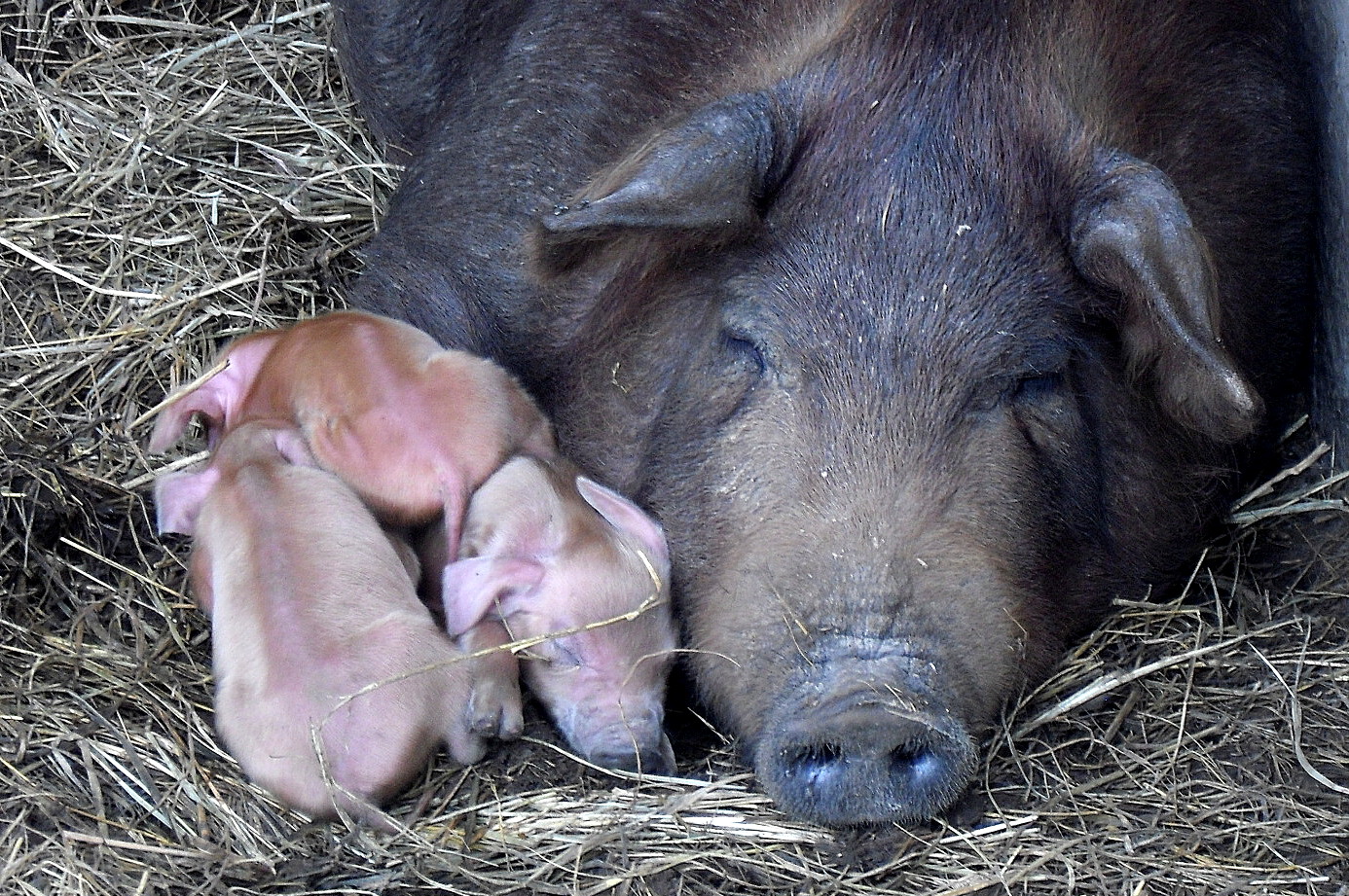
One piglet had an injured foot, so we had to do a little doctoring, which gave us an opportunity to cuddle (!) with her. This piglet is a runt and her name is Zinnia.

Heirloom seeds are one of the greatest gifts on the planet, at least to me. Great things come in small packages and I love seed packets. I collect them like a pre-pubescent baseball card junkie of olden days hoarding them in boxes and containers; I even turned my wine fridge into a seed vault.

So when we got an Easter care-package in the mail from our wonderful friends Bob and Kathy a few days ago we carefully cut the tape and opened the box with rapt anticipation. Care-packages are always exciting. Among the goodies, plastic Easter eggs filled with treats and treasure as well as several thought provoking books “Harvest for Hope, A Guide to Mindful Eating” by Jane Goodall and “The Good Good Pig, the extraordinary life of Christopher Hogwood” by Sy Montgomery. Both authors are vegetarian, one – Vegan.

Interesting how I had just come across this article and was pondering the debate about humanely raising animals for food versus the Vegan perspective – all this after watching Food, Inc.

I find it’s important to look at all sides of an issue with an open mind. Research and contemplation of an issue so close to home is a much better alternative than ignorance.

So what else was in the box? Some nice Easter cards and news clippings with great information about farming and food, mentoring us further along this journey, and last but far from least, was a small innocuous looking bag from the gift shop at the venerable Monticello Estate. I carefully unfolded the small sack to reveal the most marvelous selections of Heirloom seeds!

A cache of 12 historic plant varieties! Cardoon, Prudens Purple tomato, Bloody Butcher corn, Lemon Balm, Early Curled Siberian Kale, Purple Calabash tomato, Fish Pepper, Brown Dutch Lettuce, Sesame, Red Calico Lima Bean, Cow’s Horn Okra, Balsam Apple. WOW! Hey, what’s Balsam Apple?

From Packet: “Jefferson planted this tender annual vine along the winding walk flower border on Monticello’s West Lawn in the spring of 1812. The Balsam Apple’s glossy, delicate foliage, small yellow flowers, and bursting orangish red fruit are a curious and unusual addition to the summer flower border. Plant the seed after the last spring frost and provide support with a fence of trellis. The vines will twine to ten feet in a sunny, fertile site”.

This year will be the year for cardoons and artichokes, multiple varieties of purple tomatoes, herbs and pink corn, unique peppers, amazing lettuces, beans of all shapes and sizes, several types of okra and Balsam Apple! What am I forgetting? Oh, I need more land…

What a wonderful Easter Sunday: heritage piglets and heirloom seeds, it doesn’t get any better than this. We also planted a mini-orchard with 10 fruit trees (orchard now totals 50), moved the chicken coop so our 27 new chicks could be closer to the house and to make room for our 7 Bantams and 6 Pekin ducklings.

Reflecting back two years ago exactly, the enormity of our move away from friends and family was sinking in. We had just lost a favorite uncle with no opportunity to say good-bye. We were alone on the holiday and phone calls to loved-ones made the distance more painfully clear. We did the only thing we knew to do, face the future and embrace it, and plant an apple tree in honor of Uncle Wayne.
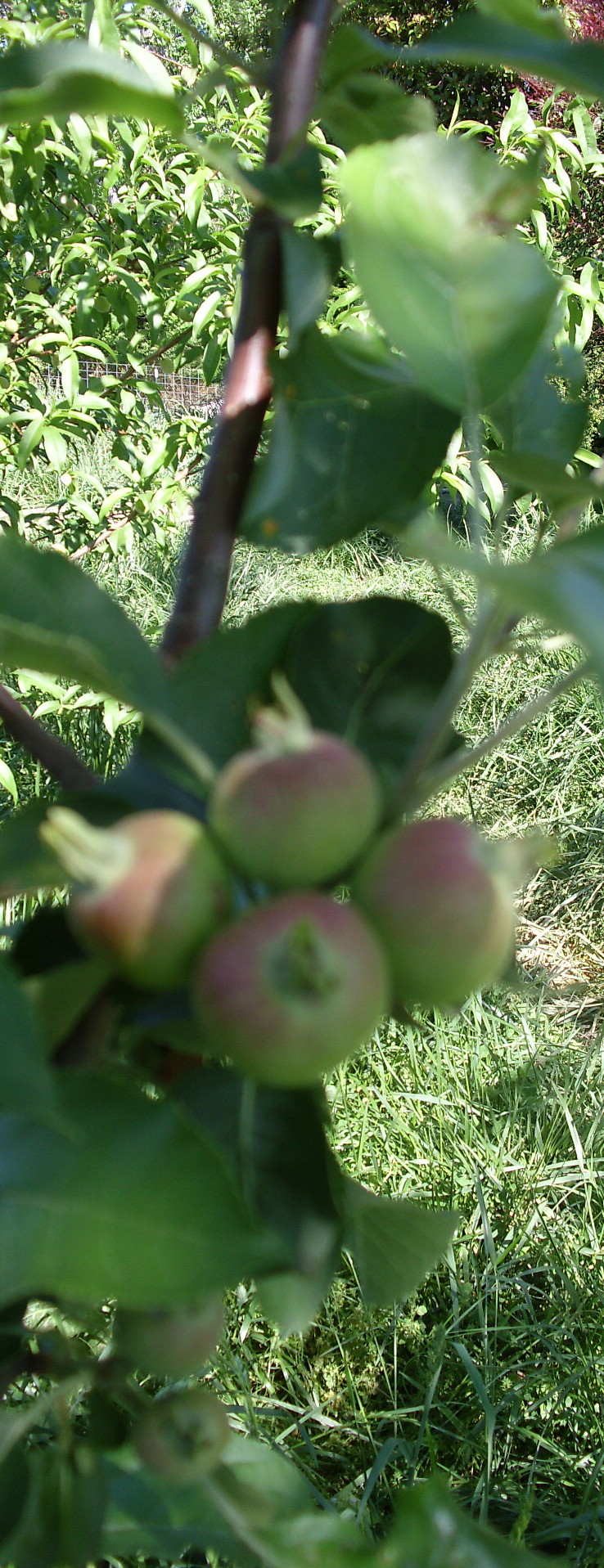
Pinkguitarfarm is in its infant stages. We keep on keeping on against various odds because we have cherished friends who have lent us huge amounts of emotional support, not to mention gifts, seeds, rotten hay, fencing, green house supplies, free pig and bull-calf castrations, community endorsements, wagon rides, songs and music, wisdom, social invitations, articles, links, books, mentoring, care packages, a skype camera, visits, wine and late night conversations. We have farmers market customers that try our vegetables and recipes even though the vegetables and recipes might seem weird, and those that buy our fabulous pork. Thank you for being a part of this crazy adventure!

There is not a sprig of grass that shoots uninteresting to me.
~Thomas Jefferson~
big picture – our pale blue dot

20 Apr

Charcuterie Challenge #4 Tasso Ham: CA/TN Roll, yes, Sushi

15 Apr

Our family has always, always, always loved Sushi, well, Sashimi, if you want to get technical about it. We love raw fish. Moving to Tennessee brought about several dramatic changes in our lives. 1. A very limited budget and, 2. A desire to eat local. So Sushi really should have been pushed beyond the back burner, or completely forgotten altogether, but in reality, ashamedly, we guiltily lurked around Japanese restaurants and when we went out to eat at these “forbidden” places, we pretended that it was always “our last time” with the knowledge that we  couldn’t afford it. Sad, but true.  Sushi addicts, yes we were.

Our lurking around Japanese restaurants has diminished significantly however, we continue to purchase Nori (dried sheets of seaweed -Sushi wraps), and make creative versions of Sushi around the house, especially on Friday nights.  That’s what we call family time.

The kids take cooked meat/or/vegetarian Sushi rolls to school packed for lunch occasionally. At one point the lunch monitor, quite concerned, made sure nothing raw presided in those rolls.  At this tiny rural school it was probably one of the last things she expected to see in a kids lunch, leave it to those crazy California transplants…

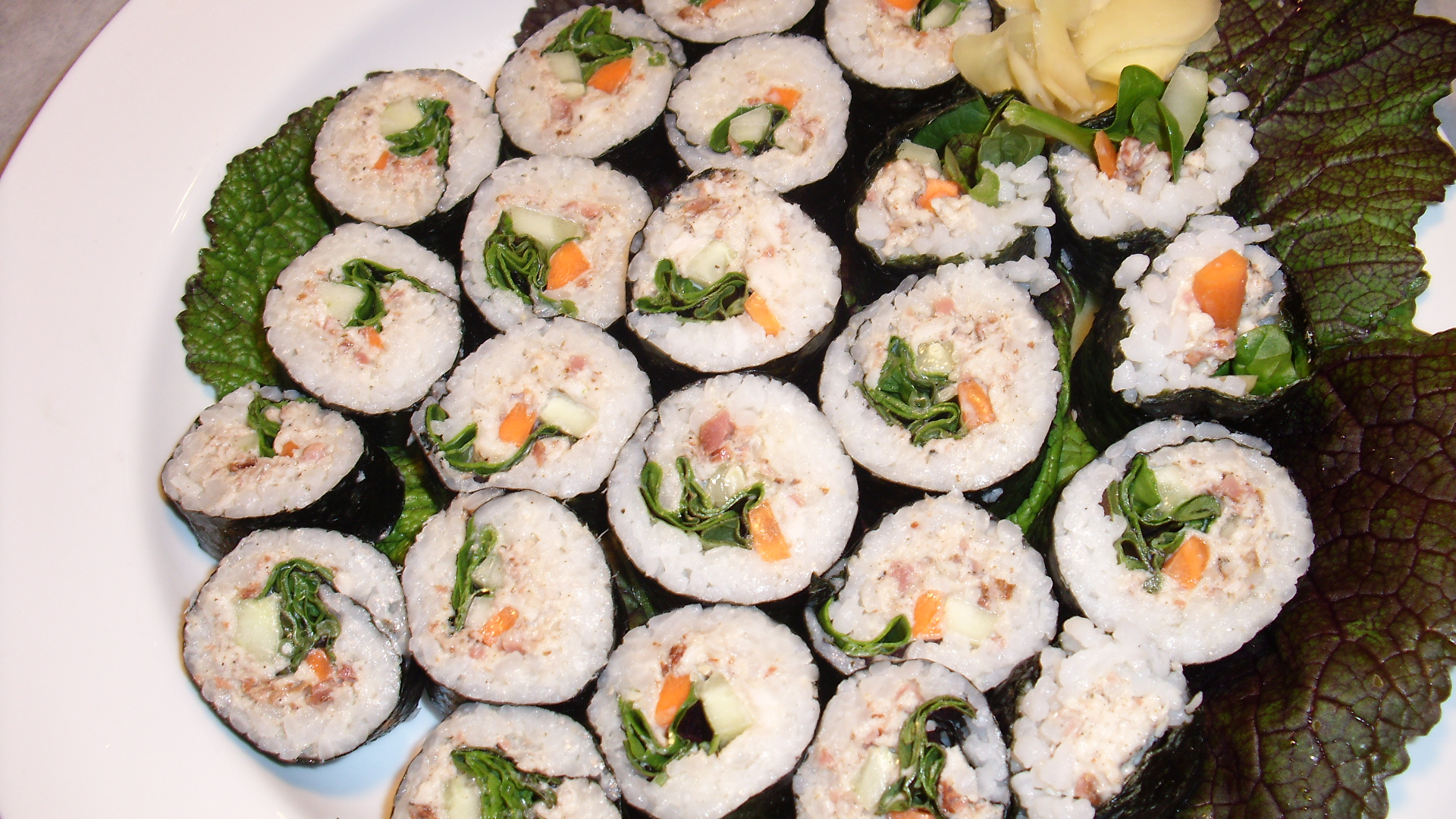
Our kids love their new life here, but really miss raw fish… So do we. Here’s an alternative, something we call our  CA/TN Roll thanks to our new-found knowledge in how to cure and smoke Tasso ham. The spicy Tasso seems to go with the seaweed and the vegetables, add the creamy mayo catfish and you’ve got something!

Tasso, pre-smoke

2 Cups sushi rice
2 Cups water
1/3 Cup Rice wine vinegar
2 Tablespoons Sugar
a pinch of salt

1 Cup baked catfish flaked* you could also use fried chopped catfish if you so desire…
½ Cup diced Tasso ham (or more!)
1/3 Cup Mayonnaise (we know mayo isn’t traditionally Japanese – bear with us, this is a take-off on a California roll)
2 carrots cut into long matchsticks
1 cucumber (peeled) cut into long thin strips
1 big bunch spinach**
1 bunch red mustard**

8 sheets of Nori

Wash rice several times until water runs clear. Add rice and water to a pot with a tight lid or use a rice cooker. Bring rice and water to a simmer and cover. Turn the heat down to low and let sit for about ½ an hour.

Combine sugar salt and vinegar in a jar and shake well. Make sure the sugar is dissolved. Add the sugar salt and vinegar mixture to the cooked rice in a separate bowl and mix well. Set aside to let cool covered with a towel.

In another bowl, combine the catfish, Tasso ham and mayonnaise.

Set up your food preparation area and ingredients for the rolls prior to making them. Set out the rice, catfish/Tasso mixture, carrot, cucumber, spinach and mustard greens in separate or combined bowls.

Lay out a bamboo mat and cover with plastic wrap (we use a 1 gallon zip-lock bag). Place Nori on top of wrap and press rice mixture onto 2/3 of the sheet. In the center, lay a 1″ section of the catfish and Tasso mixture in a horizontal line on the Nori and rice. Lay carrots, spinach, cucumber and mustard along the catfish/Tasso mixture. Roll the Nori tightly with the bamboo mat and squeeze to get everything to stick together.

Release the roll and slice it into sections with a sharp knife. Eat the rolls the way you normally eat sushi. We like soy sauce mixed with wasabi, but in this case the red mustard is spicy enough to cover the kick we’d be looking for with the wasabi.

Enjoy!

We don’t think that deep frying these rolls in a (tempura) batter would enhance health, but might be a tasty nod to the South and Tennessee, just sayin’.

* Bake the catfish until it flakes, about 30 minutes at 325 degrees. Sprinkle with salt and pepper prior to baking.

** Grown without chemicals at Pinkguitarfarm

Todd Bolton – Copperhead Road

10 Apr

The best way to see Middle Tennessee…

3 Apr

It was a busy Sunday morning at the farm. We’d finished morning chores and then hit the local home-building supply store for greenhouse infrastructure materials. No sooner had we finished lunch than the dogs started barking. In Middle Tennessee, when someone drives up your driveway they typically honk a few times. We didn’t hear any honking so we figured the dogs were barking because of Brad (it’s spring, Brad has been showing off and gobbling A LOT).

A quick peek out the window and this is what we saw.

It was Bob and Ann and they were out for a drive. Bob is a friend of ours; he’s our go-to guy when it comes to the hogs. He makes all flavors of fruit wine, a true vintner. He knows fine poultry when he sees it and negotiated a trade with me, bartering gave me two bottles of wine in admiration of my chickens – I was so thrilled by his gift, I gave him two hens. I got a bottle of blackberry and a bottle of strawberry, they are so pretty, I don’t want to open them!

Lucky for us, Bob and Ann asked us if we wanted to go for a ride!

We drove over into Hickman County and took in the beauty of the back roads, the creeks, the hills and the hollows.

Then we stopped to let the mules drink and the kids play in the creek. Though we traveled a mere 3 miles per hour, this wasn’t about ponderous plodding, oh, no! You should have seen the white knuckles on the wagon rails going down into the creek and later, back up to the road!

Though we had hours of work to do at home, this was much better for the mind and spirit.

Then we came across a horse and mule team with a lovely carriage driven by locals Sam and Michelle.

So we joined up with them and drove together. We got to meet new neighbors and see parts of the country we’d never seen before.

What a wonderfully relaxing Sunday! Of course, the work will still be there to do next weekend…

Peas, Favas and Garbanzo’s

26 Mar

Spring is here!

The Eastern Redbud and Dogwood flowers are blooming, reminding us (nagging us prettily) that it is time to plant crops!

Here in Middle Tennessee the change of the seasons is so dramatic and definitive I’m awed and humbled each time it happens and in every unique season.  Spring must be my favorite where the bleak brown/gray landscape pops verdant green seemingly overnight.  Of course this has everything to do with the warmer temps, longer days and frequent rains.

Jewelweed, good for that poison ivy outbreak that also comes with spring!

Phenology is the art of observing seasonal changes in a manner that provides clues, reminders or nudges; multiple road signs along the annual gardening loop with hints of what to do and what’s to come.  Though Mother Nature is brilliant, you know she’s also facetious because a killing frost does surprise the too early to flower fruit tree as well as those overzealous, impatient gardeners.  I would know.

Old timers around here might tell you to heed the calendar instead of planting by the moon or using methods of phenology.  Plant peas when the buttercups bloom certainly sounds great, but I would have had a little problem had I heeded that advice this year.

Old timers keep records and journals of the planting seasons for reference and future planning that go several years out.  This blog is my record, so for now, spring means planting around the thunderstorms and hoping seedlings don’t get washed away or rot in the ground.  Getting the crops in around the weeds and the bugs is a challenge and to do so immediately following the last frost is more luck than art, forget science (we’ll leave the science in the soil for now).

Phenology is interesting and valuable in that it reminds me to pay attention to the details provided by nature.  Phenology hints that I should feel the rhythm of the anticipated within an awareness of the unanticipated.  It’s a dance to a familiar tune performed by unknown musicians.  I just want to get the moves right, ya know?

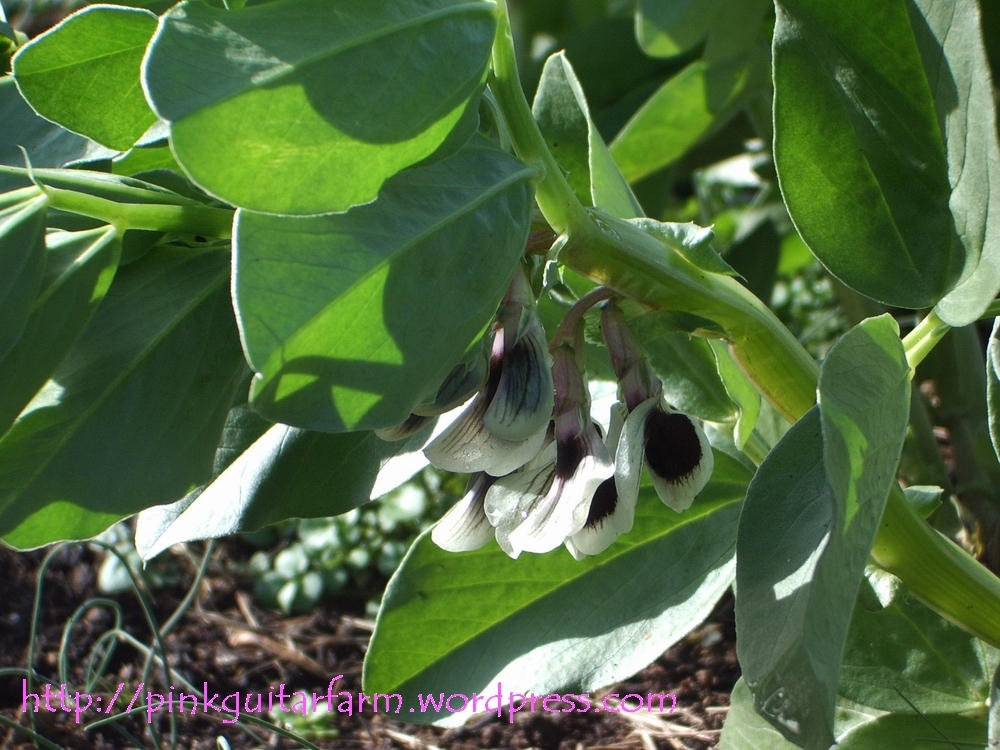
This is a fava bean flower.  We grow favas in the spring and the fall (if I’m organized enough and the weather cooperates).  I am also attempting garbanzo beans (for the first time) and peas of the shelling, snow and snap varieties, a few of the exciting crops here this spring.  Driven by the longing for tantalizingly fresh produce, I envision grilled favas, hummus dip and fresh from the vine peas savoring these flavors even before the seeds have germinated.  No doubt, a passion for the best ingredients drives my efforts in the dirt.  And these dreams do sometimes disappoint with such lofty expectations prior to harvest!

Anything can go wrong.  Every year is different; luckily something always seems to do well to compensate for what doesn’t.  Growing multiple crops in rotation through four seasons and taking precautions with some (transplants) while sowing other seeds with abandon is the best way to guarantee food production on our small farm.  Tomatoes and green beans didn’t do very well last year but our peppers and eggplants were amazing.  Who knows what this year will bring?  Hopefully gorgeous tomatoes!

Naturally Raised Beef

21 Mar

Jimmy Jones is a local third generation farmer in Williamson County who produces the best beef I have ever tasted. I visited Jimmy at his farm this month to find out more about how he does it.

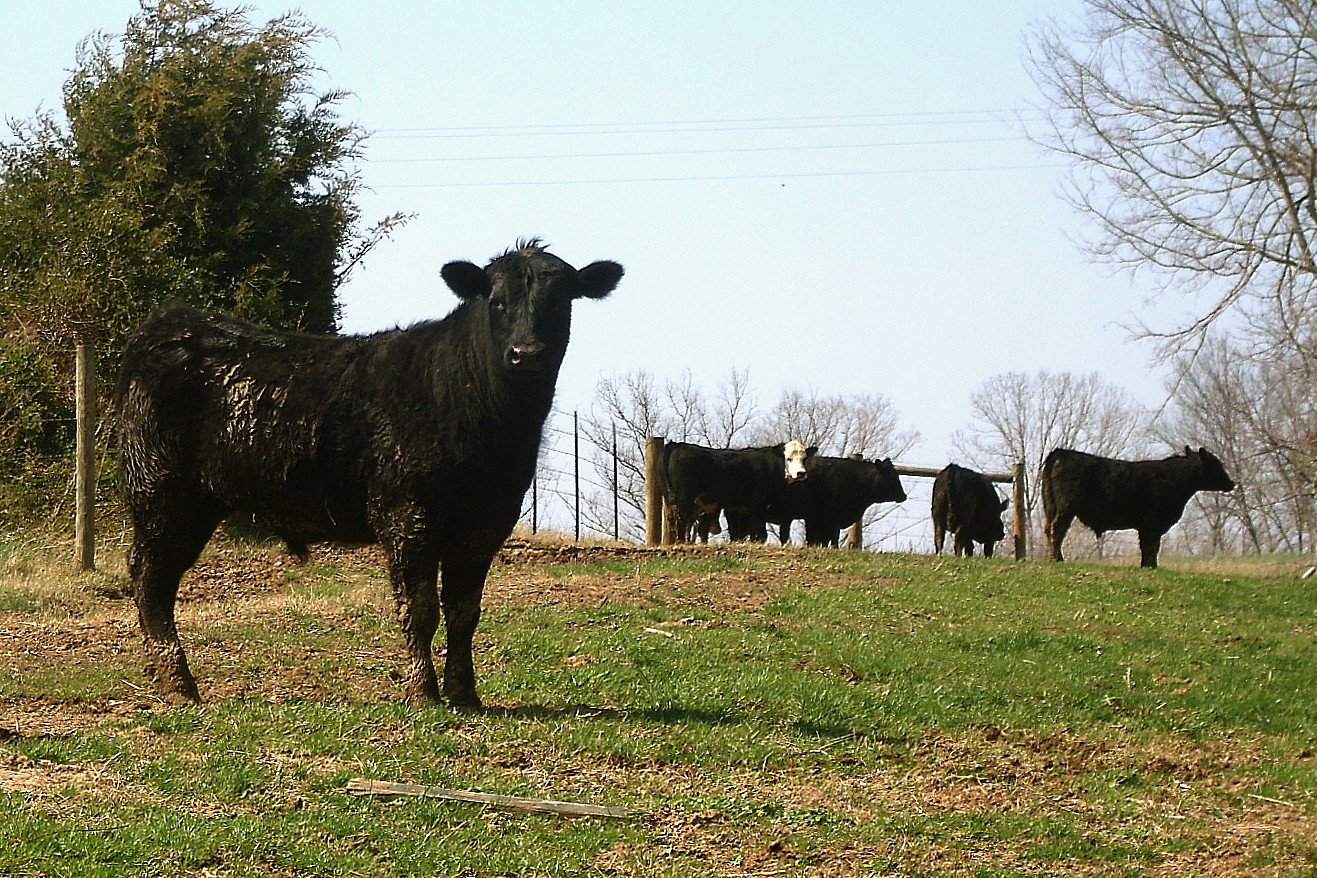
After 30 years raising Black Angus cattle, Jimmy has continuously improved his breeding stock for health, vitality and taste. Every year Jimmy starts with approximately 70 calves, then keeps only about 20 of the best to grow out for his local customers. Once the calves are weaned at 8 months, they get one dose of dewormer (with no withdrawal time for processing) and are fed out humanely on hay, grass and a blend of custom milled grains with absolutely no soy. Jimmy feels this combination of feed gives the beef the proper marbling, tenderness and correct ratio of fat to meat. No hormones, antibiotics or other chemical additives are given to any of his beef calves.

The processing of any meat might be just as important as how it is raised. Jimmy works with a local processor who will hang the meat for up to 45 days and is an expert butcher. This ensures that all of the time and effort to raise healthy, vibrant calves translates to the best beef possible.

Jimmy only has a few calves left this year, but if you don’t get a whole or half from him now, you can always reserve your beef for next year.

Contact Jimmy Jones at (615) 418-2119.

The case of the missing corned beef…

15 Mar

The March Charcutepalooza challenge was up on the Internet (challenge #3).  Brining, okay, I’m familiar with brining.  I would do chickens, very large chickens, brined for the appropriate time, rinsed and left to dry in the refrigerator for a nice pellicle and then smoked to perfection.  No worries, got lots of chicken in the freezer.

But then I came across some grass-fed brisket at C and F Meats, Co., Inc., in College Grove, TN.  I purchased a nice, center cut, well marbled five pound beef brisket following the brining instructions in the Charcuterie book to the LETTER.

The first thing I made was the standard cabbage, potatoes and carrots with the corned beef adding a little local honey and some stone-ground mustard, salt and pepper to taste.  Nothing special or creative in this traditional dish, I just craved it and wanted to see if it was different with the home brining.  It was.

Once the beef was cooked, I had to hide it in the fridge from Mr. Pink Guitar.  The dude would have just stood there at the refrigerator with the door open gnawing bites off the remaining hunk of meat until it disappeared.  He was told it was off-limits pending special recipes…

I made a soup with the cooking juices and the remaining vegetables, adding chicken stock, coconut milk, rice noodles, celery, more carrots and cilantro.  It disappeared in short order

We tried grilled sandwiches with rye bread, Swiss cheese and sauerkraut and delighted in all of the sweet and salty flavors and the wonderfully spicy notes brought about from the bay leaves, allspice, peppercorns and mustard seeds.

I was ready to execute MY special recipe.  I’d spent time taste testing the meat and thinking about how to give it a fresh, spring twist.  I had a plan and was ready to go.

But the night before I was to make my special tasty treat, it was gone, the meat, gone.  Used on pizza.  Gone.  Mr. Pink Guitar likes to make pizza.  I asked him about it and he said “you can just make another brisket”.  Uuh, it was 1 day before the deadline to post the results.  Ya think Mr. Pink Guitar considers it easier to ask for forgiveness than permission?

I have asked Mr. Pink Guitar if he would like to share his corned beef pizza recipe with you.  He says he will, so I suppose we patiently wait in anticipation of his recipe and pictures.   To his credit, he is very busy with a “real” full-time job and another full-time job on the farm in addition to playing music on Broadway in Nashville every other Sunday at Layla’s Bluegrass Inn.

So, if you learn how to brine or corn beef brisket, you will never have a problem wondering what to do with it.  It will not last long, you may have to hide it.  Even from people that don’t explore the far reaches of the refrigerator, you know the ones I’m talking about – those that think the fridge cleans itself out, those who don’t “go there” with leftovers?  So, I suppose I’ll be corning more beef!  MY recipe will be posted later.  The Chicken?  Yeah, eclipsed by the beef.  That post will come later too.

Innocent parties regarding the meatwagon (those that don’t sneak corned beef): Burley, Sophie, Lucy, Jack, Jane… Kids walking the Greats~!

It Feels Like Rain

13 Mar

Bootleg Bacon, so good, it might be illegal.

15 Feb

Since joining the Charcuterie Challenge our farmhouse has been all a-buzz about meat and preserving. We missed the duck prosciutto challenge but will make that up later, however, when the apprentice challenge was announced with a salt-cured BACON we were ecstatic, the kids got all silly and wiggly with the idea of it, after all, bacon IS a food group!

Our family got right to task with our bacon recipes. The kids lobbied for bacon dipped in dark chocolate, I figured lardons with baby chicories/endives and housemade farm cheese with a nice vinaigrette, Mr. Pink Guitar wanted to showcase his famous bacon-wrapped sweet peppers stuffed with bleu cheese.

We are newbie hog farmers, so we have pork! Or so we thought, we were ready, the hog was ready, finished on sweet potatoes (rooted right out of the field), the appointment had been made with the processor (no easy feat during deer season). Then the snow came, the truck got stuck and we missed our window. No worries, we would just go buy some local belly from someone else around here…and this is where we hit a little snag.

Local butcher shops have closed down. Most of the local processors butcher deer and the occasional farm animal, not for resale. Availability of specialty cuts of meat appear to be a thing of the past. Even with our own meat, I’m challenged to find a processor that will scald the hog, i.e. keep the skin on and get rid of the hair. Most processors around here only skin the hog, which is non-traditional and wastes a lot of wonderful fat and also means you can’t smoke your hams (hams must be smoked with skin on, or so I’m told).

What has happened, here in the South where people love BBQ and pork? Cheap meat, that’s what. Some of the best Southern food comes from living frugally. These days that frugality has been won over by the supermarket mentality and cheap prices due to volume discounts. It seems unlikely that price competition will ever be a component of specialty shops, so what about awareness of humanely raised meats and subsequent health benefits? Not likely on a mass scale, but locals I talk to are aware or coming around with regard to the lack of quality meat at the store and have concerns about what actually goes into the meat.

What a conundrum and depressing outlook for a new hog farmer! I did finally find humanely raised pork belly from a local farmer (a story in itself) so as you might imagine, I was quite relieved to have my pork belly, as I also began rethinking my farm business plan.

When we moved to the South I figured meat preservation was a given, that every town had a Benton’s, that I would be immersed in a culture of unique and imaginative tasty uses of the whole hog. Well, Benton’s is quite busy these days, but their clients are definitely not all local. The Internet and a few famous chefs just might have saved Benton’s, and if that’s what it takes, so be it! I hope more specialty shops follow their lead in this niche.

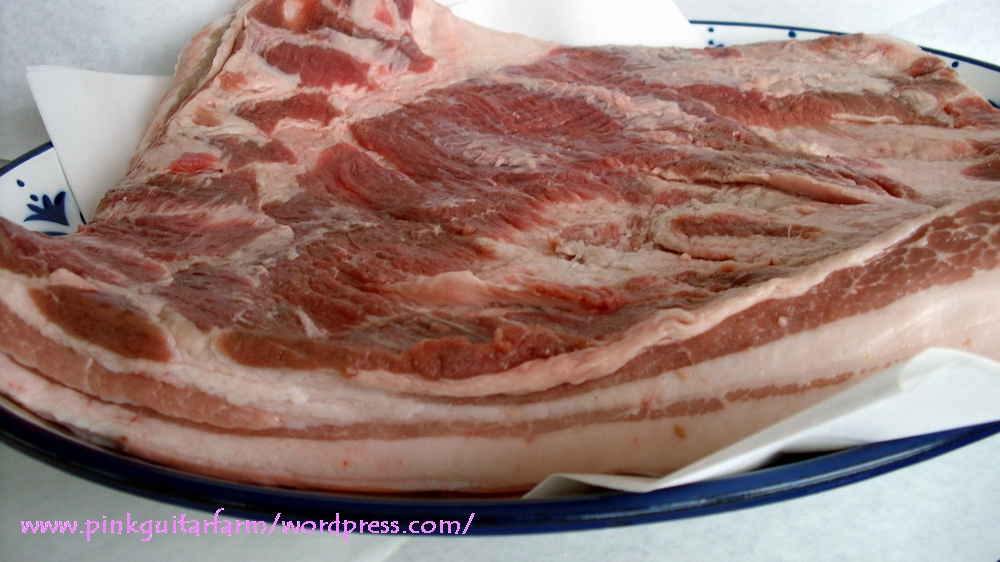
We were lucky to find our huge pork belly. We sat looking at it in awe wondering how big that pig must have been to make such an exquisitely ginormous cut of meat. No doubt, worthy of a Lady Gaga dress.

When we got our belly, we kept checking the picture in the Charcuterie book identifying the different parts of the pig to comprehend where all the goodness originates (page 34). It’s really astounding to think about the range of flavors that can be coaxed out of the pig. We are even more enamored with our Pink Guitar Porcine’s now that we sit on the cusp of comprehending their vast culinary potential.

No wonder the pig is such a huge part of history, life and culture in the South. The three words that come to mind regarding the settling of a varied unforgiving terrain, a hard farming life and long barren winters could be distilled down to: corn, whiskey and pork. Not necessarily in that order. Not only is the hog part of our biodynamic, holistic farming program as in tilling and amending our soil but the gifts provided afterward are nothing short of amazing. That is what our bacon was: AMAZING. Here is how we did it:

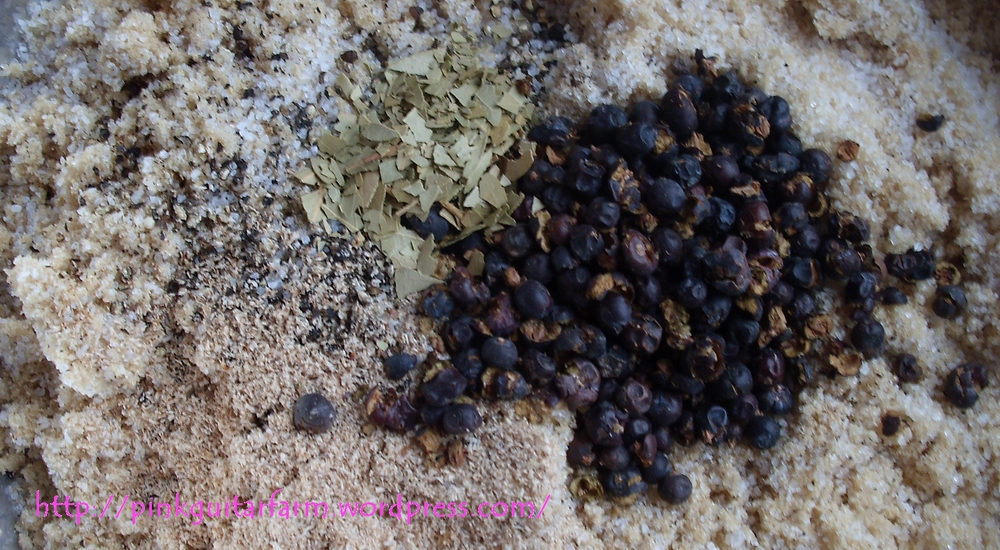
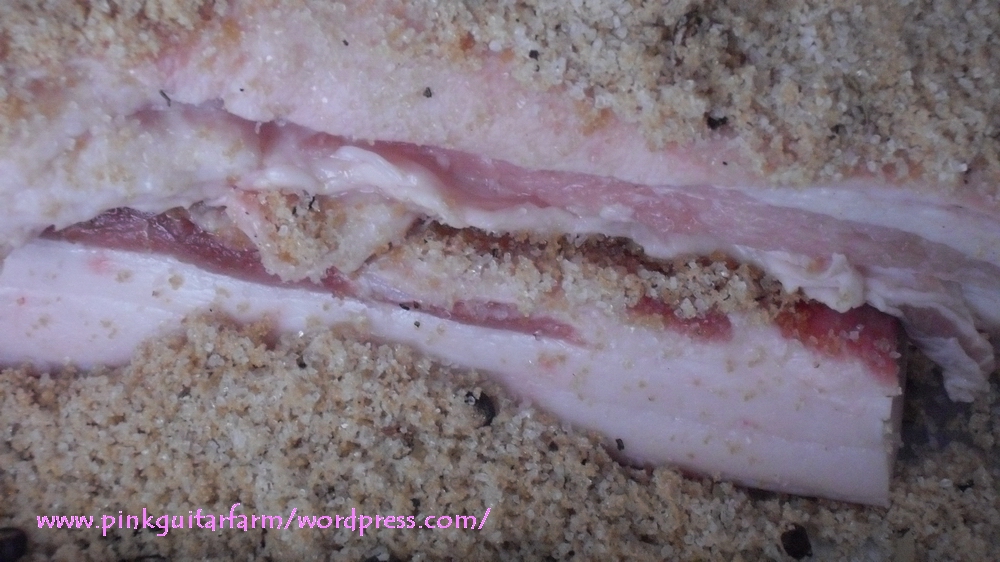
We opted for the salt/brown sugar cure with as many spices as we could find. The aroma of the juniper berries alone was enough to make me reach for the martini glasses.

Note to self, when preserving, one can never have too much salt, brown sugar or spices on hand. We did not try the pink salt this time. We avoid chemicals as much as possible, however, after researching pink salt and understanding that nitrites occur naturally in things like celery, we will keep pink salt #1 and #2 in the pantry to be used according to the minimums required by a recipe.

Isn’t it lovely? Like a layer cake except one with so many delicious future possibilities…

Oddly, I’m finding unexpected similarities between homemade bacon and moonshine here in Middle Tennessee. Of course there are books about how to make moonshine, just like there are books about making Charcuterie. Not to say that there are similarities between these two books, we’re talking completely different leagues here, but, both books are about a craft that is being forgotten, or rather, disappearing from our kitchens/backwoods, one legal, one not, crafts that are somewhat esoteric – definitely not mainstream. Both of these crafts were common practice not too long ago – when BOTH were legal.

When I went out and talked to locals about my Charcuterie Bacon Challenge I encountered skepticism, concerns about difficulty and danger – regarding curing bacon… but not about making moonshine.  Say what? How about being empowered to make superior food at home with incredible texture and flavor that is downright delicious?

Ironically, the conversations I had about bacon always seemed to turn to, what else? Moonshine. All of the locals I talked to have a greater knowledge and willingness to make moonshine than bacon (okay, I get it, I think, a cost savings? A romanticized rebel factor?  Use of real fire vs. smoke?  Whatever it is, it doesn’t translate to bacon, or does it?). Meat prices are going up. Commodity prices are rising, and that affects everything. I had a discussion with another farmer who stated that he doesn’t believe locals will be able to afford meat or meat products to the extent they are used to, in the not so distant future. I concur, the last time I checked, cheap, generic bacon was $6.00/pound. We both speculated as to whether that would help or hurt the local farmer who raises his/her own grains and inputs. The consensus was that if meat got too expensive and the regulations on smaller, local farmers became too onerous, meat could go underground, just like moonshine did, and where raw milk may be headed…

So what, exactly, are the similarities in comparing the crafts of curing bacon and making moonshine – in addition to both being methods of food preservation?   They require similar inputs: corn goes into the pork and is used in the production of moonshine.  Sugar may be used in the curing of bacon or in assisting with the fermentation of the mash/beer for moonshine, advance planning is required, timing is important and attention to detail is critical for safety. The end product can be wonderful if done correctly, or dangerous, if done without care. Both of these crafts are rarely attempted at home (as far as I know) and yes, one of them is illegal. And no, I don’t intend to ever break the law.

Lost art or not, dangerous or not, I found my home cured and smoked bacon to be so incredible that I don’t see myself purchasing that squidgy, cloying stuff pumped full of whatever, passed off as bacon at the grocery store EVER again. I’m a bacon snob now and it’s not about expense (well, within reason) or pretending to be a foodie or considering myself special because I found some long-lost artisan skill. I’m a bacon snob now because it’s a no-brainer, especially if you buy a whole or a half hog, it’s just BETTER.

Applewood smoked

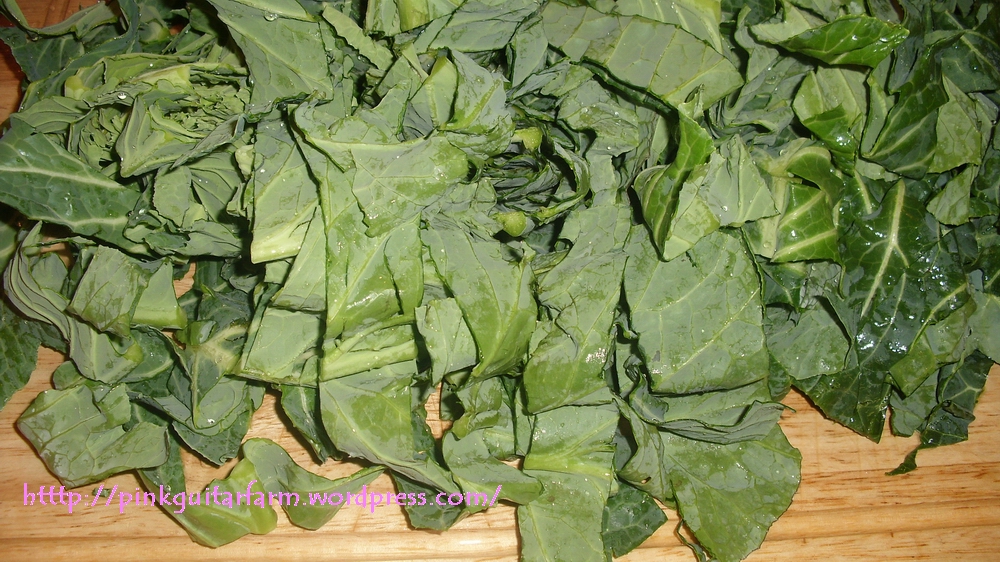
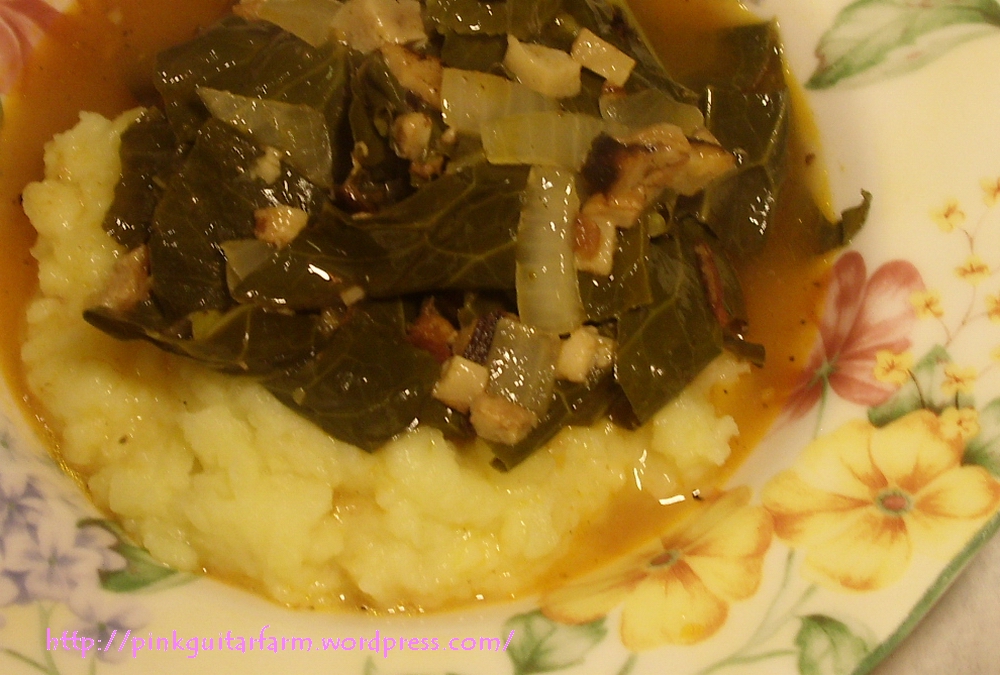
The smoked result smelled fantastic. I looked at it, cut off the rind, examined it closely and smelled it again. It begged for greens. I don’t know why and wasn’t planning on preparing greens. I have a deep respect for Southern Greens. As you may know, Southern Greens are traditionally prepared with stock or water, a ham hock or bacon drippings, greens and some type hot pepper sauce or pepper spice. I have the utmost respect for a dish that was inspired by destitution and scarcity, but this bacon compelled me to make my own version (perversion) of greens, so I hope this is not seen as a gross misinterpretation of a traditional recipe, rather, a way to eat tender collard greens with a potlikker so good, you might want to drink it.

Bloody Mary Bacon Greens

2 Bunches of collard greens, (I used collard – they stand up well to the heat, you can use kale, mustard or cabbage greens but these will change the flavor. If you use spinach, Swiss chard or beet greens make sure to add them chopped just a few minutes before serving).

Chop a 3 pound slab (or so) of home cured, applewood smoked, bacon that has been rendered at low heat in the oven at 200 degrees for a few hours.

2 tablespoons mustard seeds
¼ cup mustard (regular or spicy)
1 teaspoon Cayenne pepper
As many cloves of garlic you can stand, smashed, chopped.
2 medium yellow onions, chopped.
As much of your favorite hot sauce as you like
A splash of Worcestershire

Sea salt to taste
Seasoning salt to taste
Cracked black pepper to taste
½ a bottle or more of your favorite Bloody Mary mix.

10 medium Yukon Gold potatoes, about 5 pounds, chopped and boiled until tender, smashed with butter, a little milk, salt and pepper (and, if you like, chopped garlic or nutmeg). You want these mashed potatoes firm.  These are prepared separately as a way to mop up that awesome potlikker.

Saute the onions until tender (in bacon drippings if you wish) add the bacon and the greens and fill the pot half way with water.  Cook down on medium heat for about 10 minutes.   Add seasonings, spices and Bloody Mary mix and cook for about 20 to 30 additional minutes, until the greens are tender.

The smoked bacon should dictate the salt and seasoning, remember, it may be different every time you make it due to the nature of the size of meat that you cure and the way it is cured.

This pot of greens was soulful, harmonious, delicious, decadent, and sumptuous, and the little bits of fat were square silky pearls – like finding treasure! No, I did not feel guilty.

The idea behind using local humanely raised meat is to use more parts, sparingly. Any left over potlikker? Add it to a cooked pot of black-eyed peas or navy beans! This dish was stretched over several meals and we enjoyed every bit of it.

Not only has the Charcuterie Challenge encouraged me to step up my blogging and get outside my comfort zone in the social networking scene to “meet” and discover a wonderful community of like-minded meat lovers, it has also gotten me off the farm and “out there” to get to know and interview my own community here in TN. After talking to one local – a fixture at Pucketts in Leipers Fork last weekend, he offered to teach me how to make moonshine. I was talking to him about bacon, and looking for a Zen Master Charcuterie mentor…But, of course the conversation turned to moonshine. So, this local, someone I’ve talked to several times, stipulated that if I research how to make “shine” legally and get all of my paperwork in order, he would teach me. I hope this is not my equivalent of “when the student is ready the teacher appears”. I’m waaaaay more interested in Charcuterie! He thinks I should start my own Micro-Distillery (now how do you think the market is out there for Pink [Guitar] Label Whiskey?). Maybe I can negotiate a trade, I learn to make moonshine legally and in exchange, teach him to make his own bacon.

The way I understand it, moonshine is just like cured bacon, whiskey is similar to cured and then smoked bacon – they are the same thing, one is just aged in smoky barrels which gives it more color, depth and flavor.

Oven roasted

So, in the spirit of supporting my local peeps, here is a little bacon dessert (with a touch of moonshine)

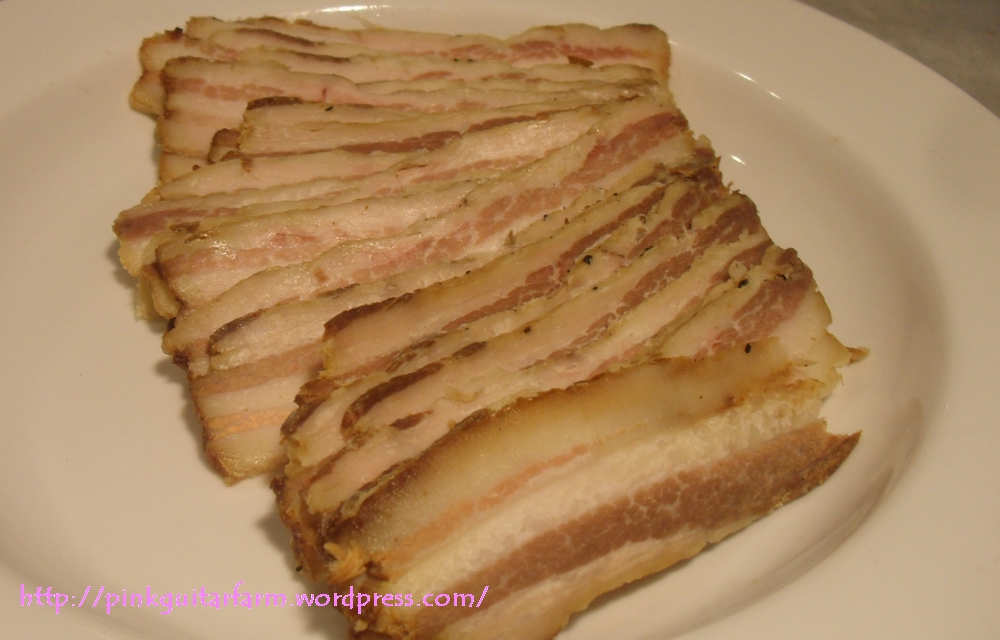
I ended up with 4 slabs of bacon out of that big belly. Two of them were cured and smoked, two of them were cured and roasted at a low temp. I liked the smell of the baked bacon because the spice was noticeable, yet subtle – better for dessert!

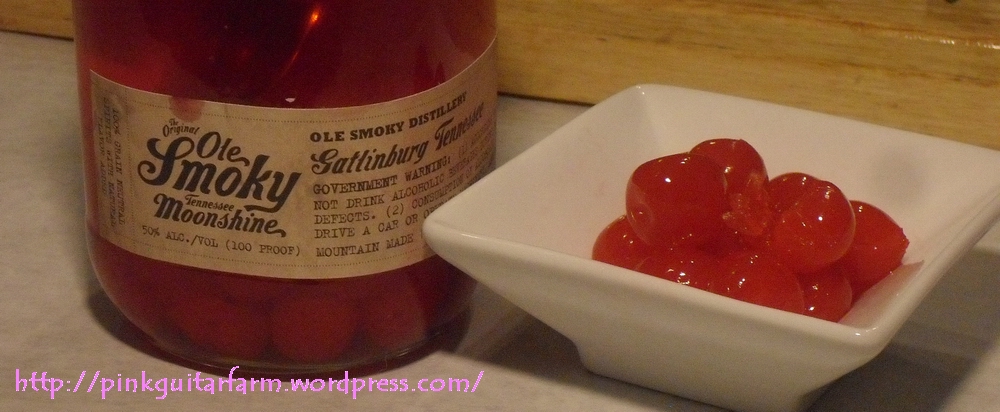
Roll sliced bacon and place on skewers.  Bake until brown and crispy.  Top it off with a moonshine cherry and then spoon some homemade or processed caramel over the top.  What is a moonshine cherry, you ask?

Moonshine cherries

The above cherries were purchased in a Tennessee liquor store and are made in Gatlinburg, TN.